February 7, 1983 · Scioto-Darby Road and Five Points Pike, near Circleville, Ohio
The Circleville Letters
On February 7, 1983, a school bus driver outside Circleville, Ohio, stopped to tear down a hand-lettered sign and found a loaded pistol rigged to fire. It was the latest turn in an anonymous letter campaign that had already run for years. A man went to prison for the trap. The letters kept coming. The hosts split on whether the handwriting or the person points to him.
SIMONEFebruary 7th, 1983, about 3:30 in the afternoon. A country crossroads outside Circleville, Ohio, where Scioto-Darby Road meets Five Points Pike. Flat, open farmland. Winter. It's on a school bus route. And someone has put up a sign.
ELIA road sign?
SIMONENo. A homemade one. Hand-lettered, fixed to a post by the side of the road where the bus driver can't miss it. And it's an obscene remark about her daughter.
ELIAbout the driver's daughter.
SIMONEThe driver is Mary Gillispie. Whoever made that sign knew exactly who'd be coming down that road, and exactly what she'd do when she saw it.
ELIShe rips it down.
SIMONEShe does. She pulls over, climbs down, and tears it off the post. There's a little box fastened to the board behind it, so she takes the whole thing— sign, board, and box— back onto the bus. And then she finishes her route.
ELIWith it sitting on the bus.
SIMONEWith it sitting on the bus. She gets home and the box is glued shut, so she works it open. Inside is a loaded .25 caliber pistol rigged to fire when the sign was pulled.
The mailbox
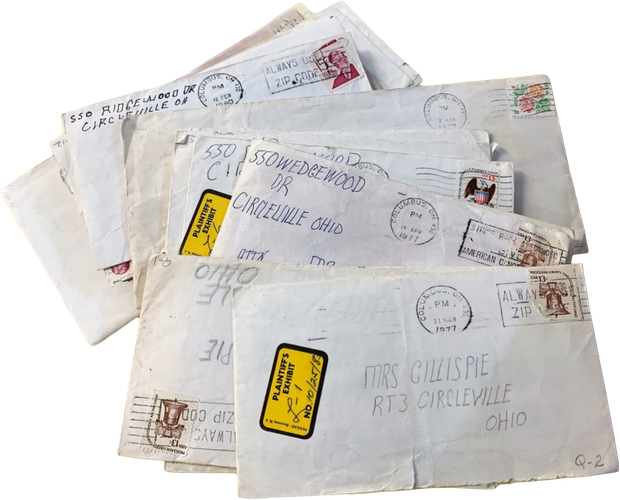
Beginning in the spring of 1977, anonymous handwritten letters began arriving in mailboxes around Circleville, Ohio. The first ones accused school bus driver Mary Gillispie and school superintendent Gordon Massie of having an affair. No source has ever established that the affair was real. It was the letters’ accusation, nothing more.
- The writingBlock capitals, no return address, mostly postmarked Columbus
- The reachHundreds of recipients over nearly two decades, including Ron Gillispie, other residents, local businesses, government offices and newspapers
- The first targetBus driver Mary Gillispie, accused in the letters of an affair that no source has shown was real
- The endThe letters stopped arriving in 1994
ELIAccording to the sheriff, that same night, after the polygraphs, Freshour admits to writing 40 or 50 of the letters. He still denies the booby trap.
SIMONEAccording to the sheriff? Is there a recording?
ELINo. Freshour himself said they were recording him that night, and there's no tape of any confession.
SIMONEAnd for the rest of his life, Freshour said he never said it. So that's a sheriff telling a newspaper what a man said in a room with no tape running.
ELIOr a man walking back the I'll give you this much. It doesn't show up in any trial record anyone's found.
SIMONEThen it's the sheriff's word against his.
- 01 / 04 · 1983, THE TRAP
At about 3:30 p.m. on February 7, 1983, Mary Gillispie found a hand-lettered sign with an obscene remark about her daughter at a crossroads on her bus route. She pulled it down and put the sign, its board and a small box on the bus. At home she opened the glued box and found a loaded .25-caliber pistol, rigged to fire when the sign was pulled. The gun was traced to her brother-in-law, Paul Freshour. He said it had been stolen weeks earlier and failed police polygraph testing. His wife, Karen Sue, who was divorcing him, told police she had found torn-up letter drafts in their home.
- 02 / 04 · 1983, THE TRIAL
Freshour’s attempted-murder trial began on October 24, 1983. He was convicted and received the maximum, 7 to 25 years. He was never charged with writing the letters. Some of the handwriting samples he gave the sheriff were copied from actual letters and others were dictated. The defense’s own examiner set the copied pages aside, saw signs of disguise, and found nothing pointing to a different writer, but gave no flat identification.
- 03 / 04 · 1983–1994, THE LETTERS CONTINUE
Anonymous letters kept arriving throughout his imprisonment, some addressed to him. Prison officials said that at times he had no pen or paper and was searched repeatedly. How the letters continued has never been officially explained. He was paroled in 1994, the year the letters stopped.
- 04 / 04 · 2021, TWO EXPERTS
CBS’s 48 Hours revisited the case. Forensic document examiner Beverley East compared 49 letters with Freshour’s known writing and concluded one person wrote them, Freshour. Former FBI profiler Mary Ellen O’Toole reviewed 98 letters and doubted he was the writer, calling the author “not a highly educated person.” Freshour held a master’s degree.
SIMONEOkay, now it's my turn. Because how they got there matters. Handwriting examiners compare Freshour's writing to the letters. And how do they get his sample? The sheriff sits him down at a table with the actual Circleville letters on it. And some of the pages he writes are him copying those letters.
ELISome of them. The rest were dictated.
SIMONEIt's still backwards, Eli. You hand a man the thing you're trying to match, ask him to reproduce it, and then act surprised when it looks similar? And the jury hears all about how that sample was taken.
ELIThey do. But here's what else they hear. The handwriting expert the defense hired, their own examiner, testifies that he set the copied pages aside. He worked from the dictated pages and from writing in Freshour's personnel file, because that's a person's natural hand. And in the dictated writing, he says he sees signs Freshour was trying to disguise it.
SIMONETrying to disguise it? That's one man's read of somebody writing with a sheriff watching.
ELIThat's the defense's own expert, and he says he can't find anything pointing to a different writer.
The handwriting, or the person
Same caseThe physical chain and the handwriting point to Freshour.
The gun was his. He said it had been stolen and failed police polygraph testing, and torn-up drafts of letters turned up in his home. A document examiner later tied the handwriting to him across the years, and Eli points out that even the defense’s own examiner found nothing pointing to a different writer. Eli says plainly that he cannot fully explain the letters that arrived while Freshour was in prison, even with the fingerprint reports, and that he cannot explain away everything else either.
The person in the letters is not the man they convicted.
Some of the handwriting samples were copied from the very letters being matched, the defense’s own examiner never said flat out it was him, and the sheriff’s claim that Freshour admitted writing some of the letters has no recording behind it. A former FBI profiler read the writer as less educated than Freshour, who held a master’s degree. The letters kept coming while he was locked up. Simone does not claim to know who wrote them. She is not convinced it was him.
Whether Freshour wrote the letters has never been proven, and he was never charged with it. The two experts worked from overlapping, but not identical, sets of letters, and Beverley East’s methodology was not independently verified. How letters continued during his imprisonment is unexplained. Reports of Freshour’s fingerprints on letters mailed after his arrest differ (about a dozen versus 26, a window that includes about eight months he was out on bail), were not raised at trial, and the underlying lab reports have not been independently reviewed. The sheriff’s account of a partial admission has no recording and no trace in the trial record. Ron Gillispie’s 1977 death was ruled an accident; family members questioned that, and no official reopening has been located. The Gillispie–Massie affair appears only as the letters’ accusation.
ELIWhen 48 Hours went back to the case in 2021, researcher Marie Mayhew, who'd been through the case file, told them Freshour's fingerprints were on about a dozen of the letters postmarked while he was in prison.
SIMONEHis fingerprints? On the prison letters?
ELIThat's what she reported. And I want to be careful because it's messy. Another account of the same records says 26 letters and counts from the day he was arrested Which includes about eight months he was out on bail. It never came up at trial. And Freshour always said there were prints on those letters, and none of them were his.
SIMONESo, it's a dozen, or 26, or none.
ELIDepending on who you ask. I'm not going to pretend it closes anything. But it's the closest thing to a physical answer anyone's offered for how those letters kept coming. Without it, all I have are guesses. Someone outside helping him? Or a prison that wasn't as airtight as officials said.
SIMONEAnd you can't document either of those?
ELINo. I'll say that plainly.
SIMONEThank you.
ELIFirst, Beverley East, a forensic document examiner. She compares 49 of the anonymous letters with things Freshour wrote under his own name, including a letter he sent a friend, and she finds his quirks. There's a capital G in that personal letter, and I'm quoting her: "A very unusual G. Looks like a six." Number 6. She finds the same 6-shaped G in the anonymous letters.
SIMONEA G that looks like a six?
ELIAnd then the zip codes. When Freshour writes a zip code, he wobbles on the 3s and 2s, and one digit looks like it could be either. In her words, it's like he's not sure which number he means. Then she goes to the envelopes on the anonymous letters. I found the same mistake.
SIMONEOkay, that's a good detail.
ELIIt's a very good detail. She's looking at letters from 1977, letters from the '90s, letters postmarked while he was in prison, and her conclusion is, I would say one person wrote all of these, and the one person is this person, Paul Freshour.
From the first letter to the 48 Hours experts
1970s to 2021- Anonymous block-capital letters begin arriving in Circleville mailboxes. The first accuse Mary Gillispie of an affair with the school superintendent. No source has shown it was real.
- After a phone call at home, Ron Gillispie says he is going to confront the letter writer and drives off with a .22 revolver. His truck leaves the road and hits a tree. The coroner rules the death an accident.
- Mary Gillispie finds the rigged pistol behind a hand-lettered sign on her bus route. It is traced to her brother-in-law, Paul Freshour.
- Freshour’s attempted-murder trial opens Oct. 24. He is convicted and sentenced to 7 to 25 years. He is never charged with writing the letters.
- Letters keep arriving while he is imprisoned. In December 1993 the producers of Unsolved Mysteries receive a postcard signed “The Circleville Writer” before filming.
- Freshour is paroled. The letters stop arriving the same year.
- Freshour dies at 70, still saying he did not write the letters.
- Two experts review the letters for CBS and reach opposite conclusions about the writer.
Two readings
No winner“Even with the fingerprints, I can't fully explain the prison letters. But I can't explain away everything else either.”
- “I'm not calling it evidence, I'm calling it behavior.”
- “A line that clean doesn't happen by accident.”
- “Both of those are facts.”
“I don't know who wrote them. I'm just not convinced it was him.”
- “It's still backwards, Eli.”
- “You're pointing at when they stopped. I'm pointing at the 10 years they didn't.”
- “Both are facts, and they point in opposite directions. That's this whole case.”
In their own words, from Episode 17.
No verdict.
SIMONEPaul Freshour, at the very end of his sentence and about to walk out, agrees to sit down on camera. 10 years in prison for the booby trap. He gets his one moment on national television, And he doesn't use it to talk about the gun.
ELIWhat does he talk about?
SIMONEThe letters. He says, I'd really like to see someone really look at this case. On the letters. Reopen the letter part of it.
ELIA man convicted of attempted murder, asking people to look harder at the thing he was never charged with.
SIMONEIf you wrote them, Eli, that's the last thing you'd ask for.
ELIOr it's exactly what you'd ask for, if you were confident nobody could ever prove it.
- If letters kept arriving while the suspect was in prison, what does that say about who wrote the earlier ones?
- How much should one handwriting expert’s certainty weigh when a second expert reads the same letters and sees a different person?
- If no one was ever charged with writing the letters, what does it mean to call the case closed?
Hear the whole debate
A new case every Sunday
One short email when each new case file opens. Unsubscribe any time.