September 1934 to August 1938 · Cleveland, Ohio
The Mad Butcher of Kingsbury Run
Between 1934 and 1938 someone left at least twelve bodies in and around Cleveland’s Kingsbury Run. Only two were ever named, the police records have since vanished, and the man sent to stop it, Eliot Ness, never did. The hosts agree on how little is known. They split on whether a good read is worth a verdict.
ELIAll official Cleveland police records on this case have since been lost, destroyed, or removed. Not redacted. Gone.
SIMONEYou're doing the thing where your voice changes.
ELIThen catching himself and resetting to professional. I fact-checked for a living for the better part of a decade, Simone. This is the case that would have ended my career. There's no primary record to check against. You're working from newspaper morgue clippings, secondhand accounts, whatever survived in private hands. I don't— okay. I don't love working without a floor under me. Let's get back to what we do have.
The ravine and the lakefront
The killer’s victims were found in and around Kingsbury Run, Cleveland, and along the Lake Erie shore. Most were decapitated and many were dismembered. The police never made a case against anyone.
- The victimsAt least 12 official, some sources count 13
- The placeKingsbury Run and the Lake Erie shore, Cleveland
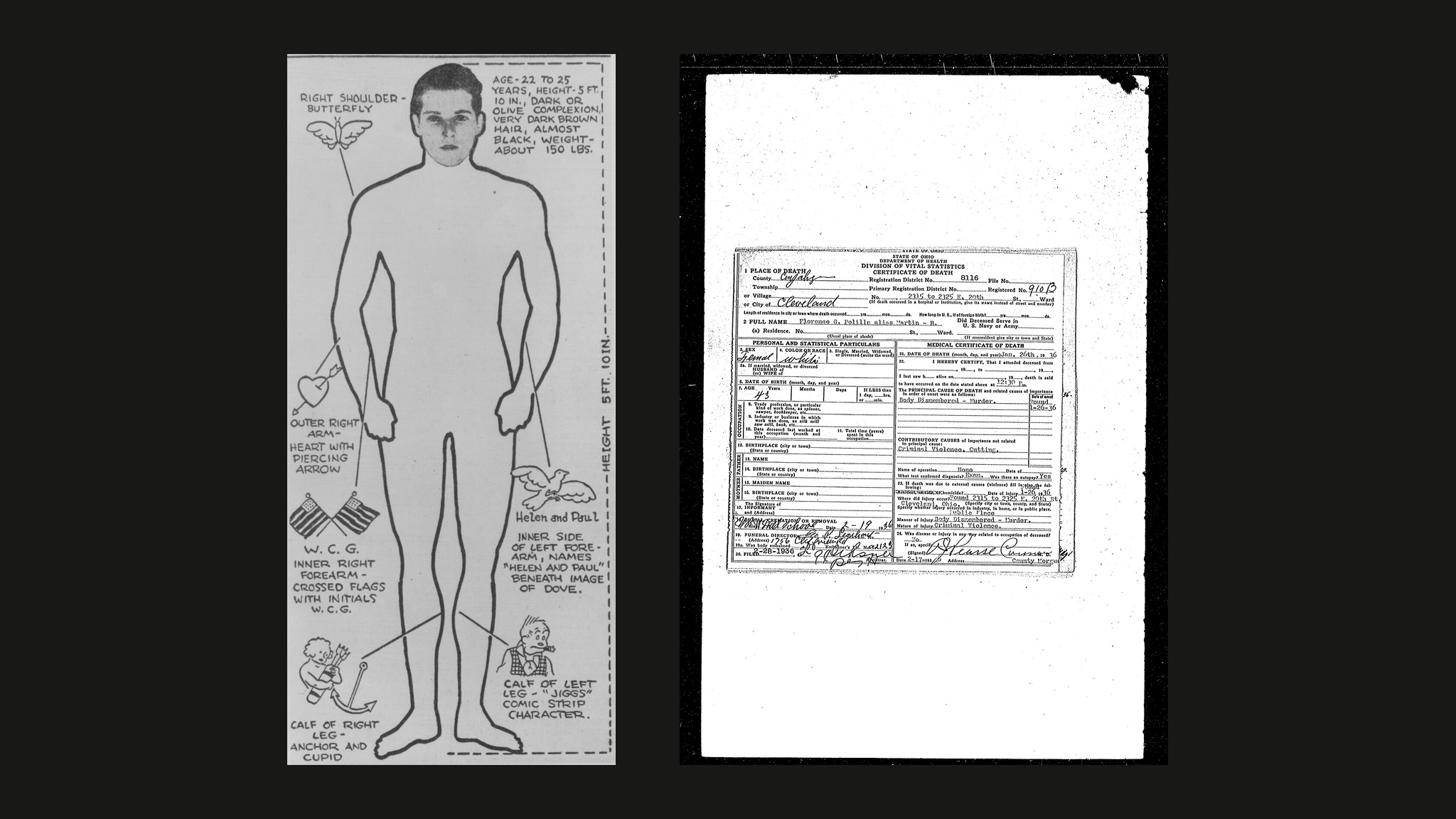
- The namesOnly two ever identified, both by fingerprints
- The recordsAll official police records lost, destroyed or removed
ELIIt should be the number. The number is what nobody in this city could get straight, and it's still not straight. Of up to 13 victims, two, two were ever identified by name.
SIMONESay that again?
ELI2.
SIMONE11 people killed and dismembered in an American city in the 1930s. And 11 of them are still, today, just bodies. No names. That's not a cold case footnote, Eli. That's the whole horror of it.
- 01 / 04 · THE COUNT
At least 12 official victims, found between September 1934 and August 1938. Some sources count 13, including the 1934 “Lady of the Lake”.
- 02 / 04 · THE NAMES
Only two were ever positively identified, Edward Andrassy and Florence Polillo, both by fingerprints. A third, tentatively Rose Wallace, was never officially confirmed.
- 03 / 04 · THE RECORDS
According to the Cleveland Police Museum, all official police records on the case have since been lost, destroyed or removed.
- 04 / 04 · THE NEW WORK
In August 2024 the Cuyahoga County Medical Examiner and the DNA Doe Project began exhuming and DNA-testing unidentified victims, funded by a single donor. No identifications had been announced as of August 2026.
ELIConvicted, actually convicted, of a nearly identical murder years later. A coroner tried to retrofit him into Kingsbury Run because the MO matched.
SIMONERetrofit is doing a lot of work in that sentence.
ELIIt's the right word. A conviction for one murder isn't evidence for a different one just because the wounds look similar. I'll say that against my own case as much as I'd say it against yours.
Three men, no conviction
Same caseSay plainly that nobody knows.
Dolezal’s confession is compromised, Johnson’s link is thin and secondhand, and Sweeney has no charge and no forensic tie. Opportunity and profile are not evidence, and with the records gone there is no floor to check against.
Read the pattern, not the paper trail.
Dr. Francis Sweeney failed two polygraphs from the era’s leading examiner, had field-surgery training, a documented history of alcoholism and psychiatric breakdown, and an office next to the morgue. None of it is forensic. She thinks the read is right anyway.
Zero convictions against any of the three men for these murders, and a failed polygraph is not physical evidence. The story of decades of threatening postcards from Sweeney to Ness, and the claim that Ness avoided prosecuting him to protect his political standing, are each single-source.
SIMONEPsychiatric breakdown severe enough to be documented. Alcoholism that gets worse in a straight line right alongside the killings. An office near the morgue that gave him quiet, unquestioned access to exactly the kind of space and materials this killer would have needed.
ELINone of that is a charge. None of it's forensic. A failed polygraph in 1938 isn't admissible evidence of anything. It's a tool, not a verdict. And Keeler's own reputation doesn't make the result a conviction.
SIMONEIt's not nothing, Eli.
ELIThere's a theory that Ness had a personal reason to want Sweeney gone quietly instead of charged publicly. A cousin, a political liability. Protecting his own name instead of getting a conviction. I want to flag that clearly. That's inferential. It's a shape people draw around a gap, not something anyone's produced a document for. I'm not saying it's wrong. I'm saying we don't get to say it on this show like it's established. Agreed.
From the lakefront to the lab
1934 to 2026- The first victims are found in and around Kingsbury Run. Some sources count the “Lady of the Lake” among them.
- At least 12 official victims. Only two are ever named, Edward Andrassy and Florence Polillo, both by fingerprints.
- The last of the official victims is found. The killer is never identified.
- Ness, who personally interviewed Dr. Francis Sweeney, orders a raid that burns the Kingsbury Run shantytowns: 35 officers, 11 squad cars, 63 men detained.
- Frank Dolezal is arrested, confesses to killing Florence Polillo in self-defense, then recants, claiming coercion. He is found hanged in custody with six broken ribs. His death is ruled a suicide.
- Willie Johnson is executed for a separate 1942 murder with a similar pattern. He is never conclusively linked to Kingsbury Run.
- The Cuyahoga County Medical Examiner and the DNA Doe Project begin exhuming and DNA-testing unidentified victims.
- The case is officially unsolved. No identifications have been announced.
Two readings
No winner“I don’t know who did this.”
- “A failed polygraph in 1938 isn’t admissible evidence of anything.”
- “A conviction for one murder isn’t evidence for a different one just because the wounds look similar.”
- “The discipline here is saying that plainly instead of picking the story that resolves best.”
“I’m reading the pattern, not the paper trail.”
- “That’s not a cold case footnote, Eli. That’s the whole horror of it.”
- “I think the read is right even without the document.”
- “This isn’t a closed case dressed up as one.”
In their own words, from Episode 09.
No verdict.
ELII don't know who did this. Dolezal's confession is compromised. Johnson's link is thin and secondhand. Sweeney has no charge and no forensic tie, whatever else he has, whatever it cost the man who chased him. The discipline here is saying that plainly instead of picking the story that resolves best.
SIMONEAnd mine is— I think it's Sweeney. I think the read is right even without the document.
- Is a read that fits the profile worth anything when there is no forensic tie and no records?
- How much should a failed 1938 polygraph count for?
- If DNA puts a name on one of the unidentified victims, what changes about this case?
Hear the whole debate
A new case every Sunday
One short email when each new case file opens. Unsubscribe any time.